
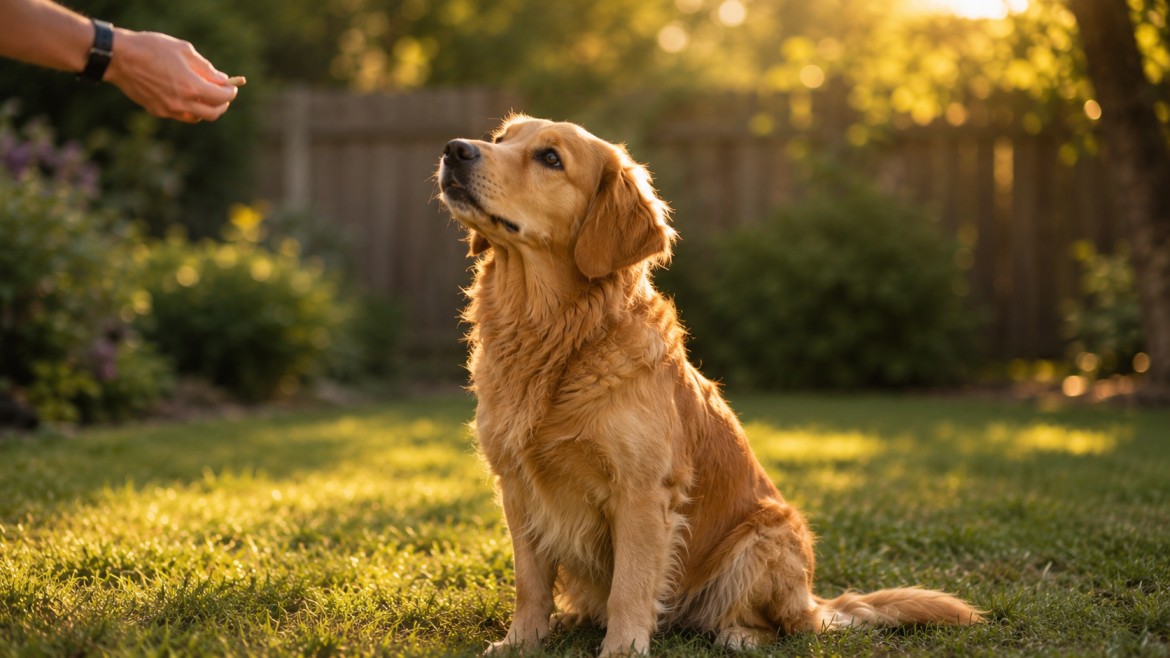
Your dog jumps on every guest, spins in circles while you're making dinner, and won't stand still for two seconds when you try to clip on the leash. Sound familiar? The good news is that one command fixes most of this - sit - and it's usually the first thing a dog learns to do reliably.
Most dogs can learn to sit in just a few days of short, daily practice sessions - no yelling, no physical pushing, just a treat and good timing. Below is the exact method trainers use, plus a common mistake that actually slows dogs down rather than helping.
What you need before you start
No special equipment required - just:
- Small, soft treats your dog can swallow quickly (bits of chicken, cheese, or training treats)
- A calm space with few distractions for the first sessions - your living room beats the dog park
- Five to ten minutes, two or three times a day
What's the fastest way to teach a dog to sit?
The most popular and fastest approach is the lure-and-reward method. It's the go-to technique professional trainers reach for first, because it works with most dogs within the first few tries.
Here's how it works, step by step:
- Stand or crouch in front of your dog while they're standing. Hold a treat where your dog can smell it, but can't grab it yet.
- Bring the treat right up to your dog's nose, then slowly lift it up and back over their head.
- As your dog's head follows the treat upward, their rear end naturally drops toward the ground.
- The moment their rear touches the floor, praise immediately and give the treat. Timing matters here - the reward needs to land the instant they sit, not a few seconds later.
- Repeat five or six times in one session, without saying "sit" yet - your dog is still learning the physical motion.
- Once your dog sits reliably every time you lift your hand with the treat, start saying "sit" right before you lift your hand.
- Gradually fade the treat out of your hand - do the same hand motion empty-handed, and deliver the treat from your other hand or pocket after they sit. That empty-hand motion becomes your permanent hand signal.
Once your dog responds reliably to the hand signal alone, you can slowly reduce that too, until the spoken word "sit" is enough on its own.
Why shouldn't you physically push a dog into a sit?
Some older training guides still suggest pressing down on a dog's back or hips to "place" them into a sit. The American Kennel Club explicitly advises against this, since it can be intimidating or confusing for the dog - your dog doesn't understand why they're being pushed, they just feel pressure and discomfort.
Luring is both faster and more pleasant for your dog, because the dog arrives at the rewarded position on their own, by choice. That difference matters a lot for how much your dog actually enjoys training sessions.
An alternative method: capturing instead of luring
If your dog isn't very food-motivated, or just doesn't track a lure well, there's a more passive technique used by trainers at Best Friends Animal Society called "capturing":
- Watch your dog throughout the day and wait for them to sit on their own - dogs naturally do this several times a day anyway.
- The moment their rear touches the ground, praise and reward.
- After a few repetitions, your dog connects "sitting = reward" and starts offering sits in front of you on their own.
- Only then do you add the word "sit," saying it right as they sit.
This method takes a bit longer, but it's a great option for dogs that food doesn't motivate strongly enough to follow a lure.
How long does it actually take to teach this command?
Most dogs master the basic sit motion within a few days of short, daily sessions - some get it on day one. What takes longer is getting a reliable sit outside the house, around distractions - that typically takes a few weeks of regular practice across different environments, and that's completely normal.
In practice, once your dog has the command down in the living room, move practice to the backyard, then the sidewalk, and only then around other people and dogs - treat each new level of distraction as a small step back in your expectations.
What if my dog refuses to sit or seems uncomfortable?
If your dog consistently avoids sitting, or seems uncomfortable getting into the position, that's often not a stubbornness issue - sitting is physically harder for some dogs than others. AKC describes a specific example of a trainer working with a retired racing greyhound whose hind legs simply wouldn't bend into a typical sit - for dogs like this, a different approach can help, such as teaching the sit starting from a "down" position instead of from standing.
More broadly, if your dog suddenly resists something they used to do easily, or sitting appears to cause pain, it's best to check in with your veterinarian before continuing training, to rule out a physical cause.
The biggest mistake owners make isn't impatience - it's running sessions too long, and repeating the cue over and over ("sit, sit, SIT"). That teaches your dog to wait until the fifth repetition to respond. Say the cue once, pause, and go back to luring if needed.
Frequently Asked Questions
Is it too late to teach an adult dog to sit? No. Dogs can learn new commands at any age - the difference is in how quickly they pick it up, not whether they can learn it at all.
How many treats should I use per session? Keep them small, about pinky-nail sized, and cut back your dog's regular food a bit on heavy training days to avoid overfeeding.
My dog sits at home but not outside - why? That's completely normal early on. Your dog learned the command in one setting and needs to practice it gradually in more distracting environments before it generalizes.
Does a clicker help with teaching sit? It can - a clicker marks the exact moment your dog sits, which makes timing easier for some owners and dogs, but it isn't required for success.