
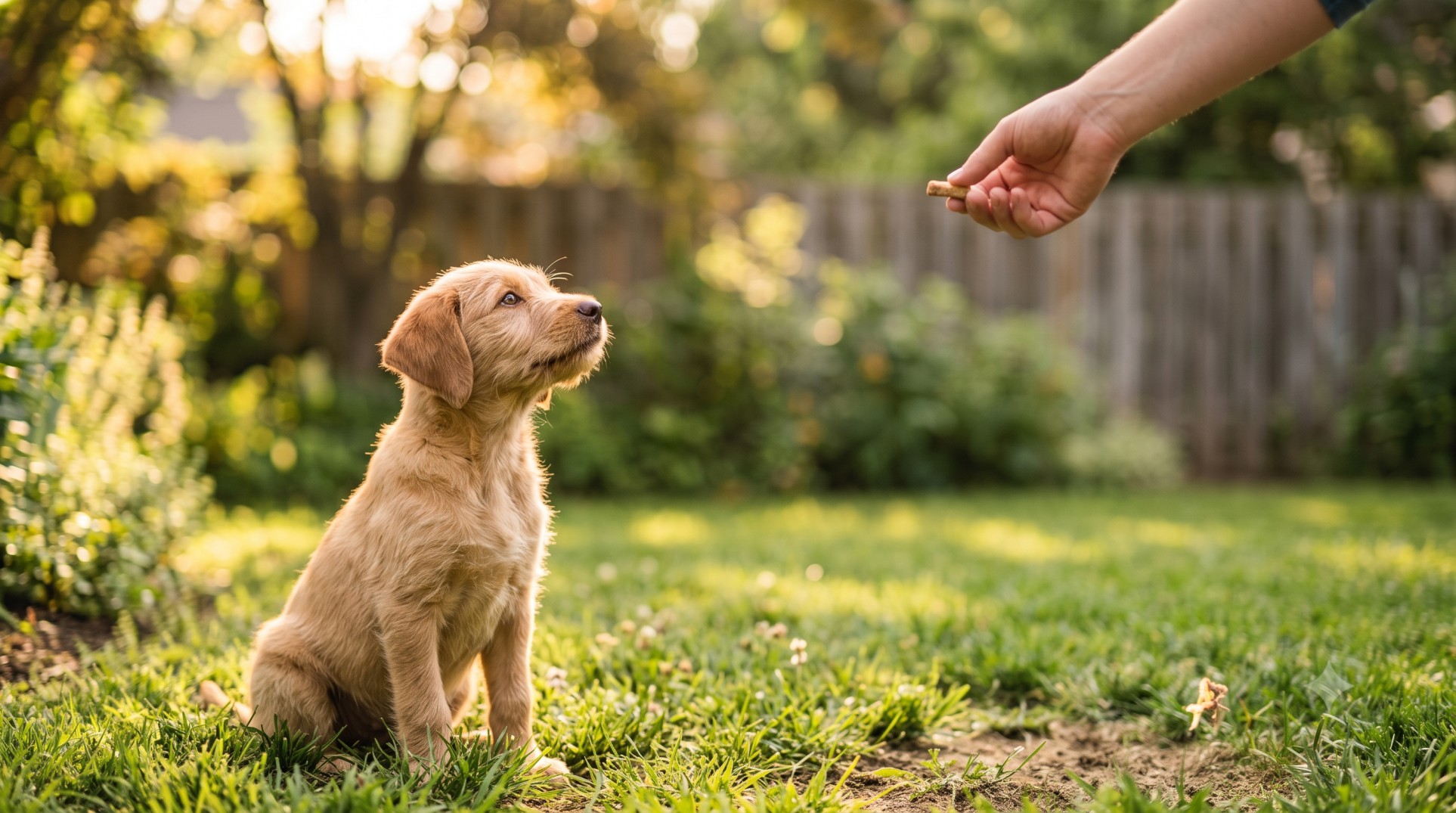
The first morning with a new puppy can be pure chaos - boundless energy, tiny teeth on everything in sight, shoes mysteriously disappearing. It's tempting to think "training can wait until they calm down a bit." But that instinct, however understandable, can lead to habits that are much harder to undo later.
The good news? Puppy training doesn't have to be complicated. Short sessions, the right rewards, and a little consistency - that's really all it takes. And you can start on day one.
Puppy training should begin as soon as your puppy arrives home, typically around 8 weeks of age. Brief sessions of just two to five minutes, repeated a few times a day, produce excellent results. The most critical period for learning and socialization runs through about 16 weeks - what puppies experience (or miss) during this window has a lasting impact on their behavior as adult dogs.
Why Training Should Start Immediately - Not "Later"
Puppies are, as the American Kennel Club puts it, true "students of life" in their first months. Their brains are literally wired to absorb new experiences and form behavioral patterns that will last for years.
Waiting on training means letting your puppy develop habits on their own - and those habits are rarely the ones you want. A dog that hasn't learned boundaries as a puppy has to unlearn established patterns before it can adopt new ones, which takes significantly more time and effort.
Training isn't just about commands, either. It builds communication and trust between you and your dog - the foundation for everything else that follows.
The Golden Socialization Window: What Happens Between 8 and 16 Weeks?
Socialization is, according to experts, arguably the most important thing you can do for your puppy during this period. The AKC notes that behavioral issues - not infectious diseases - are the leading cause of death in dogs under three years of age. This underscores just how critical early psychological development really is.
Socialization means gradually exposing your puppy to a wide variety of experiences:
- People of different ages, appearances, and mobility (including children and people using mobility aids)
- Sounds - traffic, household appliances, thunder, crowds
- Different environments - parks, stairs, cars, elevators, various floor surfaces
- Vaccinated dogs and other friendly, calm animals
The key word is gradually. Flooding a puppy with too many new experiences at once can trigger fear rather than build confidence. Each new encounter should be positive and paired with a reward.
Which Commands Should You Teach First?
Start with commands that make everyday life easier - and that happen to be the easiest to learn. VCA Animal Hospitals recommends the luring technique: use a treat as a magnet to guide your puppy into the desired position and reward immediately.
Five essential first commands for every puppy:
- "Sit" - The ideal starting command. Hold a treat above your puppy's nose and slowly move it back - as the head rises, the hindquarters naturally lower.
- "Down" - The natural next step once "sit" is reliable. From a sitting position, guide the treat slowly toward the floor.
- "Come" - Critical for safety. Practice on a long leash in an enclosed area and always reward arrival enthusiastically.
- "Stay" - Start with just one second, then gradually increase the duration before rewarding.
- "Leave it" - A protective command for moments when your puppy picks up something they shouldn't have.
Keep sessions to two to five minutes maximum. Always end on a success - even if that means finishing with something easy just so you can reward the win.
How to Reward Your Puppy Effectively
Rewards are the engine of positive reinforcement training. But the what and how matter more than most owners realize.
Treats should be small - pencil-eraser sized, as VCA recommends - so puppies stay focused on training rather than chewing. Choose something your puppy genuinely loves: cooked chicken, small cheese pieces, or high-value training treats. The more distracting the environment, the higher-value the reward should be.
Timing is everything: the reward must arrive immediately after the desired behavior. A delay of even a few seconds can confuse a puppy about what, exactly, they're being rewarded for. Once a behavior is solid, you can gradually reduce how often you reward it - but don't stop entirely. Intermittent reinforcement actually strengthens learned behaviors over time.
And don't underestimate praise and play as rewards. For many dogs, an enthusiastic "Yes! Good dog!" from their owner is every bit as motivating as a treat.
Nipping and Biting: Teaching Your Puppy Bite Inhibition
Mouthing and nipping are completely normal puppy behaviors - it's how they explore the world and play. The goal isn't to eliminate all mouthing, but to teach puppies how hard they can bite. This is called bite inhibition.
According to the ASPCA, puppies normally learn this from each other: when one bites too hard during play, the other yelps and stops the game. You can apply the same principle - if your puppy bites down hard, give a sharp, high-pitched yelp and pause the interaction briefly.
What to avoid:
- Physical punishment - this creates fear and confusion, not learning
- Wiggling fingers and toes to encourage play - this invites more grabbing
- Yanking your hand away - to puppies, this looks like a game of tug
When your puppy goes for your hand during play, redirect to a toy instead. This teaches what is acceptable to bite, not just what isn't.
Frequently Asked Questions
At what age can puppies start training? Right when they arrive home, typically around 8 weeks old. There's no such thing as starting too early with positive interactions and rewards.
How long should a puppy training session last? Two to five minutes, repeated a few times a day. Puppies tire quickly, and short, frequent sessions are far more effective than one long one.
Should I enroll in puppy training classes? Training classes offer professional guidance and structured socialization with other dogs in a controlled environment - both of which are especially valuable for puppies. Look for classes that use exclusively positive reinforcement methods.
Why does my puppy respond perfectly at home but ignores me outside? Dogs learn contextually - a command learned in one environment needs to be practiced in new settings. Gradually work up to more distracting environments, treating each one as a small step back in expectations.
This article is for informational purposes only and is not a substitute for veterinary or professional trainer advice. Always consult a qualified professional before changing your approach to your pet's training or behavior.