
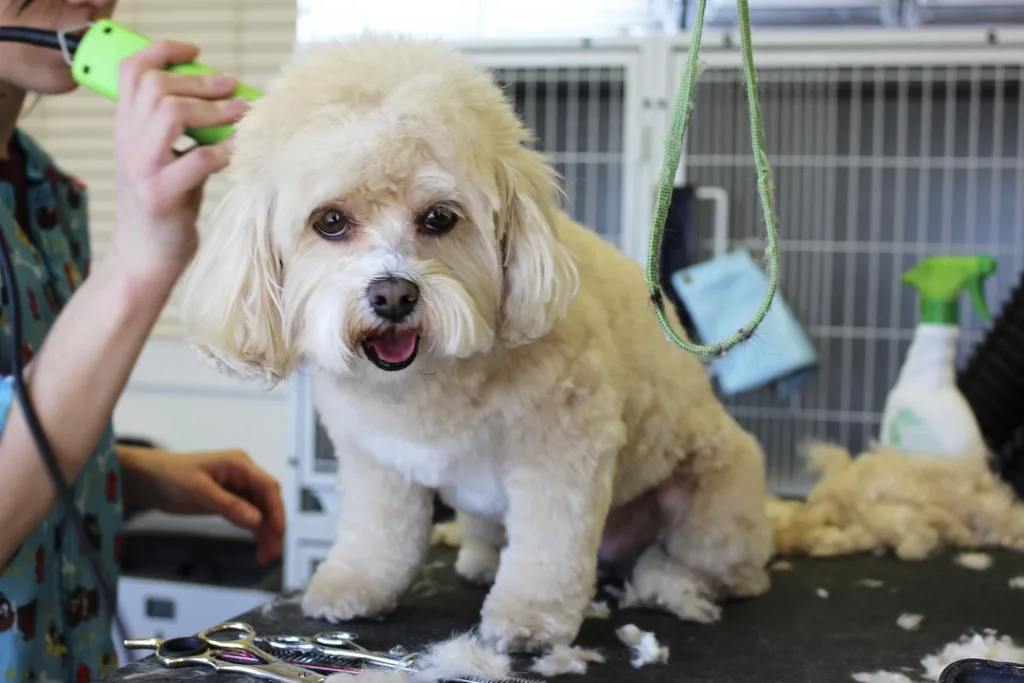
Summer arrives, your dog starts to look like a walking mop, and the grooming appointment is still two weeks away. Or maybe you simply thought: why not try it myself at home? The idea is tempting, but if you've never held a pair of clippers, it's completely normal to wonder where to start and how to avoid making a mess.
The good news is that with the right tools, a bit of patience, and a clear technique, basic at-home clipping and tidying is doable for many dogs. The honest caveat is that it isn't right for every dog or every coat type - and we'll talk about that too.
How do you clip a dog's coat at home?
Clip only when the coat is completely clean and dry, brush your dog thoroughly first so no mats or tangles remain, and run dog-specific clippers in the direction of hair growth using slow, even strokes. Leave a small safety margin above the skin instead of going too close, plan short sessions with breaks, and be realistic - some coat types are genuinely better left to a professional.
What tools do you need to clip a dog at home?
Before you even switch the clippers on, it helps to have everything within reach. Nothing unsettles a calm dog faster than half an hour of digging through a drawer for scissors.
Here's the basic kit you'll want:
- Dog clippers (or similar products available on the market) - built specifically for animals, with a motor powerful enough for a dog's coat.
- Guard combs in different lengths - for controlled, even coat length.
- A comb and brush - to prep the coat and check for any tangles.
- Round-tip scissors - for delicate areas like the paws, around the eyes, and ears, where clippers aren't practical.
- A stable, non-slip surface - a table with a mat or an anti-slip surface so your dog stands securely.
- Treats - for breaks and rewards.
One rule matters more than all the others: never use human hair clippers. They're underpowered for a dog's thick coat, overheat quickly, and can pull the hair, cause burns, or nick the skin. Keep the blade sharp, and every few minutes during a longer session check its temperature by touching it to the back of your hand - if it feels hot, stop and let it cool down.
How do you prepare your dog and coat before clipping?
Preparation is probably the most important - and most often skipped - step. Did you know that most mistakes happen before the clippers ever touch the coat?
First rule: only clip a dry coat. Never clip damp or wet fur, because it clumps, pulls, gives an uneven cut, and can damage the blade. If you've just bathed your dog, wait until the coat is fully dry before picking up the clippers.
Second rule: brush your dog thoroughly and make sure a comb passes through every part of the coat without snagging. Clipping over mats and tangles is uncomfortable for the dog and simply unsafe - the clipper can catch and pull the skin. If you hit knots you can't work out, that's often a sign it's better to see a professional.
Step-by-step clipping technique
Once your dog and the coat are ready, move on to the clipping itself. Take it slowly - this is not a race.
- Choose and attach the right guard comb for the length you want. If you're unsure, start with a longer guard; you can always take off more, but you can't put back what you've already removed.
- Hold the blade flat against the skin and guide it in the direction of hair growth. Clipping with the grain gives a smoother, more even result than going against it.
- Work in slow, even strokes, without pressing down. Let the clipper do the work rather than forcing it through the coat.
- Never clip too close to the skin. Leave a small safety margin, especially over bony areas, joints, and skin folds, where nicks happen easily.
- Handle sensitive areas with round-tip scissors - around the paws, ears, and eyes, be extra careful and patient.
- Take breaks and check the blade. Every few minutes, touch the blade to the back of your hand; if it's hot, pause and let it cool.
If you notice your dog getting restless, it's better to stop and continue later than to push through. Two or three shorter sessions beat one long, stressful one.
How do you avoid injuries while clipping?
Dogs move, and clippers and scissors are sharp - that combination is exactly why safety deserves real attention. Most injuries happen when the dog is anxious or the owner is rushing.
A few tips that genuinely help:
- Work on a stable, non-slip surface so your dog doesn't slide or jerk.
- Keep sessions short and take breaks with treats - a calm dog is a safe dog.
- Get a second pair of hands. Someone to gently steady and reassure the dog makes the job far easier.
- Don't clip an upset dog. If it's struggling, barking, or panicking, that's not the moment for a sharp tool.
- Be especially careful around bony areas, joints, armpits, and skin folds, where the skin is thin and easily cut.
When you're using scissors near the eyes, ears, or paws, this is exactly why we choose a round-tip pair - so a sudden movement from the dog doesn't end in an injury.
Can every dog be clipped at home?
Here's the honest part. Not every dog, and not every coat type, is a good candidate for a full clip at home.
Breeds with a so-called double coat - many "fluffy" dogs - can in some cases be damaged by shaving, in ways that affect regrowth and the natural insulation that protects them from both cold and heat. That's why shaving such a coat "to help the dog stay cool" can backfire. The American Kennel Club (AKC) and many professional groomers advise caution about shaving double coats.
Don't take this as a hard rule, but as a reason for caution: for some breeds and coat types, it's wiser to leave anything beyond light tidying to a professional groomer. If you're not sure what coat type your dog has or how it should be maintained, ask a groomer or vet before your first at-home clip. You'll also find helpful basics in the AKC's guide to grooming a dog at home.
Frequently Asked Questions
Can I use human hair clippers on my dog? It's not recommended. Human clippers are underpowered for a dog's thick coat, overheat quickly, and can pull the hair and cause burns or cuts. Use clippers made specifically for dogs.
Can I clip my dog while the coat is still damp after a bath? No. Always clip when the coat is completely dry and clean. Damp fur pulls, gives an uneven cut, and can damage the blade.
How often should I clip my dog? It depends on the breed and coat type, and there's no single universal answer. Fast-growing coats benefit from more frequent tidying, while some breeds only need occasional trimming - your best bet is to ask a groomer about a schedule for your specific dog.
What if my dog won't hold still? Keep sessions short with breaks and treats, get a second person to help, and never force an anxious dog. If it still isn't working, a professional groomer is the safer option.
Clipping your dog at home can be both a useful bonding ritual and a way to save money, but only when it's done patiently and safely. If you have a dog with a double or specialty coat, or you simply don't feel confident, there's nothing wrong with letting a professional groomer handle the first session while you watch - and doing light tidy-ups at home between visits.